Young European Security Conference 2027
From 17 to 18 February 2027, around 200 young people from across Europe will come together in Berlin to develop and discuss their own ideas and proposals on security policy issues with experts from academia, politics, and civil society. Join us!

This year’s conference is themed:
“A World Out of Order? – Young Perspectives on Security in Uncertain Times”
The conference is an initiative for security policy education, organized by the Schwarzkopf Foundation Young Europe and the Hertie Foundation. At a time when international conflicts and security issues are becoming increasingly relevant, we want to explore these topics together with you and other young people, and make your perspectives heard.
From 17 to 18 February 2027, around 200 young people aged 16 to 21 from across Europe will meet in Berlin. In various working groups, you will have the opportunity to learn about current security policy issues, exchange ideas, and bring attention to your concerns.
In addition to the working group program, you can look forward to interactive formats such as a World Café and discussions with experts. The highlight of the conference is a ceremonial closing discussion, where the results of the working groups will be presented and discussed with high-level guests.
The Young European Security Conference not only gives you the chance to expand your knowledge, but also to meet decision-makers, experts, and other young people interested in security policy.
The conference language is English, and no prior knowledge is required. If you are not from Berlin, we provide accommodation during the conference (arrival on 16 February, departure on 19 February), and travel costs can be reimbursed up to €140.
Working Groups
This year, all participants will again be part of a working group during the conference, where you will work in small teams on a specific topic. To ensure a good start for everyone according to their individual knowledge level, two levels will be offered for the first time this year: Intro and Advanced.
The intro level is aimed at participants with little or no prior experience in security policy topics. The advanced level is for those who already have basic knowledge and are familiar with the fundamental concepts and debates in security policy. Relevant experience could include your studies, participation in last year’s conference, or involvement in another security policy program or format.
This year’s working groups have focused on the following topics:
-
Intro Level
1. The Future of the Transatlantic Partnership: Europe and the U.S. in a Changing World
Guiding Question: What does a changing U.S. role mean for Europe’s security, and how should Europe respond?
For decades, European security has been closely tied to the transatlantic partnership. But as U.S. priorities shift and the international balance of power changes, Europe can no longer take American engagement for granted. This working group explores the future of the transatlantic relationship, the role of NATO, and Europe’s options for strengthening its own security. Participants will discuss what Europe needs from the U.S., what it can provide itself, and what a more balanced transatlantic partnership could look like.
2. The End of Diplomacy? A New Era of International Relations
Guiding Question: Are international institutions and multilateral diplomacy losing their ability to prevent and manage conflict in an increasingly competitive world?
For decades, international institutions and multilateral diplomacy have provided the framework for managing conflicts, building cooperation, and preventing escalation. But today, institutions such as the UN are increasingly challenged by geopolitical rivalries, while states are relying more heavily on bilateral deals, strategic partnerships, and power politics. This working group explores how diplomacy is changing in a more competitive international environment. Participants will examine the role of the UN, EU, G7, and bilateral diplomacy and ask whether multilateralism is losing ground – or whether new forms of international cooperation are emerging.
3. Blackouts, Cyber Attacks, Natural Disasters – Is Europe Ready for the Next Crises?
Guiding Question: How can societies prepare for major crises, protect their populations, and remain resilient when essential systems fail?
What happens when the power goes out for days, a cyberattack disrupts essential services, or extreme flooding brings everyday life to a standstill? Such crises can quickly affect hospitals, transport, communication, water supplies, and other critical infrastructure. Preparing for these scenarios is a central task of civil protection and an increasingly important part of European security. This working group explores how governments, emergency services, critical infrastructure providers, and citizens can prepare for and respond to major crises. Participants will discuss how societies can become more resilient and what role civilian preparedness, civil protection, and ensuring the security and well-being of people and communities should play in a changing security environment.
4. Words as Weapons: Who Controls What We Believe?
Guiding Question: How has information become a tool of power and security – and where is the line between strategic communication and manipulation?
A fake video, a coordinated social media campaign, or a misleading story can spread within minutes and influence how people understand a war, an election, or an international conflict. States and other actors increasingly use the information space to shape public opinion, undermine trust, and influence political decisions. At the same time, NATO and its member states have made strategic communication an increasingly important part of security policy, using communication to explain their actions, build public support, counter hostile narratives, and strengthen resilience. This working group explores how information has become a security tool, looking at disinformation, propaganda, influence operations, AI-generated content, and NATO’s strategic communications. Participants will discuss how information can be used to gain political and strategic advantage – and where legitimate communication ends and manipulation begins.
-
Advanced Level
5. Europe’s Security at a Turning Point: Rethinking European Defence
How should Europe organize its security and defence in a changing strategic environment[DE1] [AS2] [DE3] ?
Europe is facing growing pressure to strengthen its ability to defend itself. Russia’s war against Ukraine has exposed gaps in European defence capabilities, while years of underinvestment have left many European armed forces struggling to meet growing security demands. At the same time, European countries differ in their priorities, capabilities, and willingness to spend more on defence. This working group explores what Europe needs to be able to deter threats, defend its territory, and respond to crises. Participants will examine the roles of NATO, the EU, and national governments, debate defence spending and military capabilities, and discuss whether European countries can develop a more effective and coordinated approach to defence.
6. The Next Arms Race: AI, Nuclear Weapons & New Technologies
Guiding Question: How are new military technologies changing warfare and security – and can arms control keep pace?
Military technology is evolving rapidly, from artificial intelligence and autonomous systems to new nuclear and missile capabilities. But what do these technologies actually mean for the way wars are fought and for Europe’s security? Recent conflicts have demonstrated the growing importance of drones, electronic warfare, precision weapons, and other emerging capabilities, raising questions about which technologies will shape future battlefields and which capabilities Europe needs to invest in. At the same time, existing arms control frameworks are struggling to address increasingly complex and dual-use technologies. This working group explores how emerging weapons are changing warfare, deterrence, and strategic stability – and whether European states and international institutions can keep pace with the technologies they are seeking to develop, acquire, and regulate.
7. Grey Zones: Cybersecurity, Hybrid Warfare & the New Frontlines
Guiding Question: How can states respond when the line between war and peace becomes increasingly blurred?
Not every attack looks like war. Cyberattacks, sabotage, disinformation, election interference, economic pressure, and attacks on critical infrastructure can destabilize societies without crossing the threshold of conventional armed conflict. States increasingly operate in this grey zone, making attribution and effective responses difficult. This working group examines how cyber and hybrid threats are changing the nature of conflict and explores how Europe can deter, withstand, and respond to attacks below the threshold of war.
8. Star Wars: Europe’s Security Beyond Earth
Guiding Question: Why has space become a critical security domain, who is shaping its future, and how should Europe respond?
Space is no longer simply a domain of scientific exploration. Satellites have become critical to communication, navigation, intelligence, military operations, and essential civilian infrastructure, making space capabilities an increasingly important source of strategic power. The war in Ukraine has demonstrated how important these capabilities can be in practice: Elon Musk’s Starlink network has provided critical communications for Ukrainian forces, while a decision not to activate Starlink coverage for a Ukrainian operation near Crimea showed how access to space-based capabilities can become a strategic factor in war. At the same time, space is becoming increasingly contested. The United States, China, Russia, and other actors are developing capabilities that can disrupt, degrade, or destroy satellites, while jamming, spoofing, cyberattacks, and other forms of interference create new vulnerabilities. Europe remains dependent on external actors for some critical space capabilities, while private companies are playing an increasingly important role in the provision of security-relevant services. This working group explores why space has become a contested security domain, where Europe is vulnerable, and how it can protect its interests and shape the future of space security.
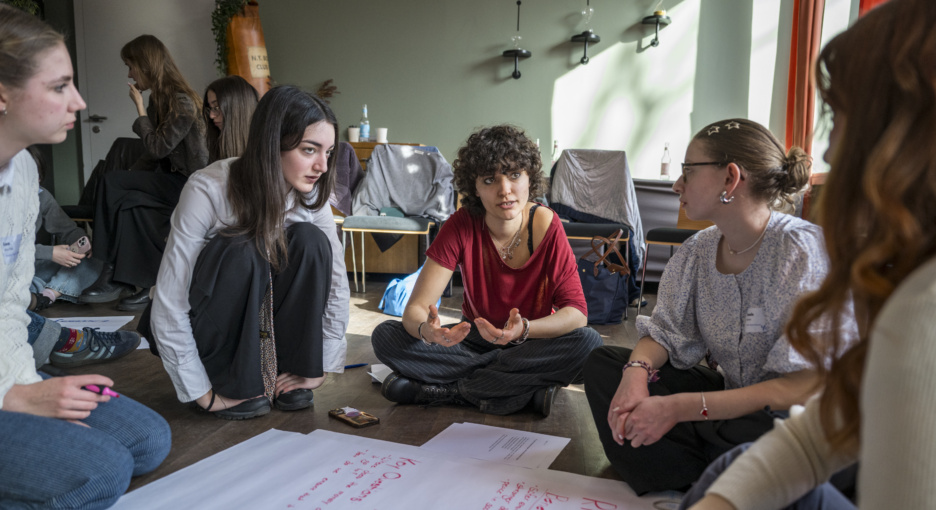
Photo: Anne Barth
FAQs
-
Participation Age
Participants must be between 16 and 21 years old at the time of the event. Please note that participants under 18 can only attend if accompanied by a teacher.
-
Communication
We have a Discord server where all participants can connect and exchange ideas. Every participant will receive a link to access it. Important information will also be sent by email, so please keep an eye on your inbox.
-
Meals
If you stay at the hostel, breakfast is included. Participants from Berlin should have breakfast at home.
Vegetarian lunch will be provided on Thursday and Friday as part of the program. On Thursday evening, there will also be a joint dinner for all participants, which is voluntary. On Friday evening, there will be a longer break so you can get something to eat before the closing session. During the closing event itself, only (vegetarian) finger food will be provided after the discussion.
Special dietary requirements can be communicated to us at a later stage. We will inform you in time
-
Travel Costs
Please only book your travel after your participation has been confirmed. All travel must be booked independently by you before the conference, and costs are initially covered by the participant. Travel expenses can only be reimbursed if they comply with the travel reimbursement guidelines. Please read these carefully before booking your travel. After the conference, we will send you a form to fill out to claim your reimbursement. The maximum reimbursement is €140 per person. Please keep all receipts (tickets, booking confirmations, invoices, boarding passes, public transport tickets, etc.) as only with proper documentation can we reimburse your costs.
-
Accommodation
If you are not from Berlin, we can provide free accommodation. You will stay at the MEININGER Hotel (Schönhauser Allee 19, 10435 Berlin)in shared rooms with other participants. Breakfast is included.
Arrival is on Tuesday, 16 February 2027, and departure is on Friday, 19 February 2027 (check-in: 3 pm / check-out: 11 am).
If you wish to stay additional nights, you will need to book and pay for them yourself.
After your participation is confirmed, we will give you the option to indicate whether you want to stay in a gender-segregated room or with specific people. We will do our best to accommodate your preferences, but cannot guarantee that all requests can be fulfilled.
-
Visa
If you need a visa for the conference, we are happy to support you with an invitation letter for the embassy. Please send an email to events@schwarzkopf-stiftung.de with the following information:
- First and last name
- Date of birth
- Passport number
- Date of issue
- Date of expiry
- Issuing authority
- Nationality
- Name and address of the embassy/consulate + email address where the invitation should be sent
-
Certificate of Participation
Certificates of participation can be issued upon request after the conference. Please note that a certificate can only be issued if you have attended all parts of the conference. If your school requires confirmation before the conference that you have been accepted, we can provide such a letter upon request. Please email us your name and your school’s name at events@schwarzkopf-stiftung.de.
-
Dress Code
There is no dress code for the conference. Just wear what makes you feel comfortable.
-
Glossary on Security Policy
Our glossary outlines some of the basic terms, concepts, institutions and legal frameworks that are important when talking about international security policy. It explains how security, violence, peace and conflicts can be defined. It also summarises the role of the United Nations (UN), explains which laws apply to conflicts, and refers to regional organisations which are important in the field.
-
Awareness
Awareness refers to being conscious of your own boundaries and those of others, as well as societal hierarchies and structures that affect our interpersonal interactions, and generally to the importance of how you and those around you are feeling. If you ever feel uncomfortable or something gives you a strange feeling, you can always reach out to the awareness team.
Conversations with the awareness team are always confidential, and your well-being is the focus. If you’re not feeling well or want to talk about a situation that you’re unsure how to interpret, you can approach the awareness team with these and many other topics. The conversation can be as solution-oriented (or not) as you prefer.
Additionally, the awareness team works on structures that prevent situations from arising in the first place and help ensure that everyone feels as comfortable as possible at the event. This includes the implementation of an awareness concept, as well as providing a designated awareness space where you can retreat if you need a break, someone to talk to or just want to have some quiet time.